
Last updated November 17, 2026
 Furnace & heating
 Heat pumps
 Ductless mini splits
 Carrier
 Trane
 Goodman
Seasonal tune-up and full diagnostic on your Carrier, Trane, or Goodman system - readings shown to you before any repair is proposed
Diagnosis first, numbers second - you approve the repair price before a single part goes in.
Get your free estimateAC Repair Troubleshooting in Boulder City: Common Problems and How to Fix Them
Here’s something we’ve learned over thousands of diagnostic calls: the service visit that runs long is almost never the one with the complicated repair. It’s the one where the homeowner says “the house isn’t cooling” instead of “the outdoor fan is running but the air from the vents is warm.” Those two sentences send a technician down completely different paths, and one of them takes twenty minutes longer before the real problem even shows up on a gauge. This guide isn’t a DIY manual. It’s a lesson in diagnostic literacy – how to read what your Boulder City system is telling you, describe it accurately, recognize the two or three fixes that genuinely belong in your hands, and know the warning signs that a small symptom is heading toward the most expensive part in the unit.
Quick Answer
Most Boulder City AC problems trace back to five failure modes: refrigerant loss, a failed capacitor, a frozen evaporator coil, a burned-out condenser fan motor, or dirty evaporator coils. Three of those – refrigerant, motor, and coil cleaning – require a licensed technician. The other two often start as symptoms you can identify and describe accurately before you call, which shortens the diagnostic and gets you a real answer faster. If your system is blowing warm air, tripping the breaker, or icing over, that’s your cue to stop troubleshooting and call (888) 906-2267. We answer 24/7, with fast dispatch from 7am to 7pm, Sunday through Friday.
Styles & brands we work with
- AC installation
- Furnace & heating
- Heat pumps
- Ductless mini splits
- Carrier
- Trane
- Goodman
Table of Contents
- The Symptom-to-Cause Matrix: Reading Your System Like a Technician
- The 60-Second Pre-Call Check That Actually Helps
- The Three Fixes That Are Genuinely Within Homeowner Scope
- Refrigerant Loss: Why “Just Adding Freon” Is Never the Fix
- Warning Signs a Minor Symptom Is Heading for Compressor Failure
- Documenting Symptoms with Timestamps: The Detail That Cuts Diagnostic Time
- Why Boulder City’s Desert Conditions Stress AC Systems Differently
- Brand Matters Less Than You Think – Diagnosis Matters More
The Symptom-to-Cause Matrix: Reading Your System Like a Technician
When a technician walks up to a system, they don’t start by guessing. They start with the symptom and work backward through the refrigeration cycle. You can do the same thing from the inside of the house. Here’s how the five most common failure modes present themselves in Boulder City homes:
- Refrigerant loss – Air from the vents is cool but not cold, the system runs constantly and never reaches setpoint, and you may see ice on the large copper line at the outdoor unit. The compressor sounds labored. This is a slow leak, not a sudden loss, in nearly every case.
- Capacitor failure – The system hums but the outdoor fan doesn’t spin, or the compressor tries to start and clicks off after a few seconds. This is the single most common no-cool call we see, and it’s often a cheap part with an obvious symptom.
- Coil freeze – Little or no airflow from the vents, ice visible on the indoor coil or the refrigerant lines, and the system may run but produce nothing. This is either low refrigerant or restricted airflow, and the two look identical from the thermostat.
- Condenser fan motor burnout – The compressor runs and the unit gets hot to the touch, but the fan blade doesn’t turn or turns slowly. In extreme cases the system trips the breaker because the compressor is overheating.
- Dirty evaporator coils – Cooling is weak across the whole house, airflow feels reduced, and the system runs longer than it used to. No single dramatic symptom, which is exactly why it gets ignored until it compounds into a freeze or a compressor problem.
Notice what these have in common: none of them is “the house is hot.” Each one describes what the equipment is physically doing. That’s the shift this guide is asking you to make. If you take nothing else from this page, take that. Our AC Repair Boulder City team hears the difference on every call, and the difference shows up in how fast the diagnosis lands.
The 60-Second Pre-Call Check That Actually Helps
Before you dial, spend one minute gathering real information. This isn’t about fixing anything – it’s about walking to the phone with facts a technician can use instead of a feeling. Here’s the sequence:
- Read the thermostat setpoint and the actual room temperature. Not “it’s warm” – the numbers. A system holding 82°F against an 78°F setpoint is a different problem than one holding 74°F against the same setpoint.
- Put your hand over a supply vent for ten seconds. Is the air cool, room temperature, or warm? Is the airflow strong or weak? Write down which one.
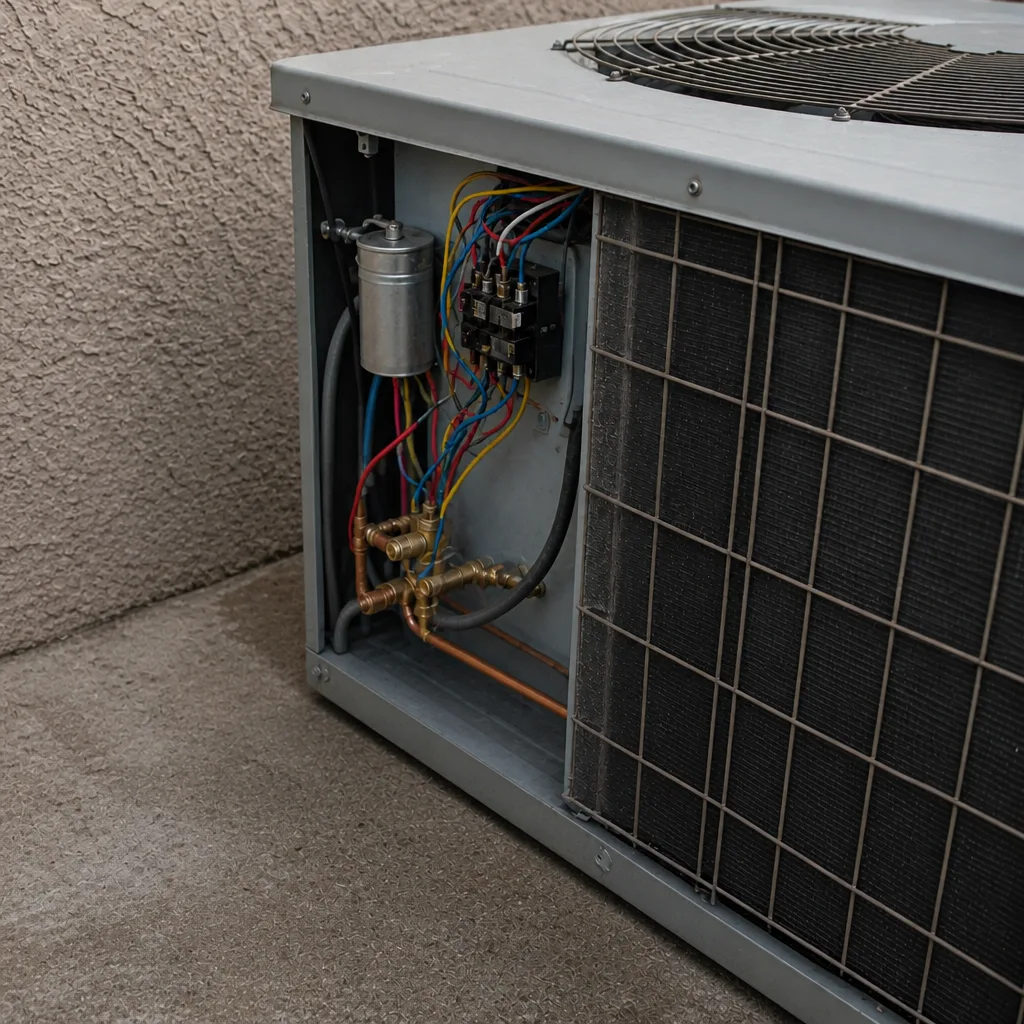
- Go outside and look at the condenser unit. Is the fan spinning? Is the compressor making noise? Is there ice anywhere on the copper lines? Is the unit shaking or rattling?
- Check the air filter. Pull it and hold it up to a light. If you can’t see light through it, that’s your answer for one big category of problems.
- Look at the breaker panel. Is the AC breaker tripped? Has it tripped more than once?
Five questions, one minute, and you’ve just given a technician the diagnostic starting point they’d otherwise spend ten minutes building. In our experience, this is the difference between a call that goes straight to the right system and one that bounces between possibilities. If any step reveals something alarming – a tripped breaker that won’t reset, ice forming on the indoor unit, or a burning smell – stop and call (888) 906-2267. Those are not “wait and see” symptoms.
The Three Fixes That Are Genuinely Within Homeowner Scope
We’re not going to pretend everything requires a service call. Three problems are real, common, and safe to handle yourself. Here’s what they are and – just as important – when they actually apply.
1. The tripped breaker
An AC compressor draws significant current, and a breaker trip can happen for legitimate reasons during a hard startup on a 110°F afternoon in Boulder City. Reset it once. If it holds, monitor the system and see if it happens again. If it trips twice in the same day, or won’t reset at all, stop – that’s a sign of a failing compressor, a shorted motor, or a wiring problem, and none of those get better with another reset.
2. The outdoor disconnect
Many systems have a pull-out disconnect box mounted near the condenser. It’s a safety switch, and it can be pulled or partially dislodged. If your thermostat has power and the indoor blower runs but the outdoor unit is completely dead – no fan, no compressor hum – check whether the disconnect is fully seated. This applies only when the outdoor unit is totally silent. A unit that hums but doesn’t start is a capacitor problem and falls outside homeowner scope.
3. Thermostat recalibration
If your system is cooling fine but the thermostat reads two or three degrees off from a separate thermometer, you may be dealing with a calibration or sensor placement issue rather than an AC problem at all. Move the thermostat’s reading source away from direct sun, lamps, or supply vents, and see whether the gap closes. A thermostat reading high because it’s sitting in a sunbeam will make a healthy system run constantly.
That’s the list. Anything involving refrigerant, capacitors, motors, coils, wiring, or the compressor itself is off the table for homeowner repair – not because we want the work, but because those components can hurt you. Capacitors hold a dangerous charge even after power is cut, refrigerant under pressure causes frostbite and displaces oxygen in a closed space, and the compressor circuit carries current that doesn’t forgive mistakes. If you’re looking at any of that, AC repair is a phone call, not a weekend project.
Refrigerant Loss: Why “Just Adding Freon” Is Never the Fix
This is the most important correction in this guide. A system that’s low on refrigerant has a leak, full stop. Refrigerant doesn’t get consumed like fuel – it circulates in a sealed loop, and if the charge is low, some of it left through a joint, a valve, or a coil pinhole. Topping it off without finding the leak means the system will be low again, and each cycle of low charge and top-off damages the compressor a little more.
What a proper diagnosis looks like:
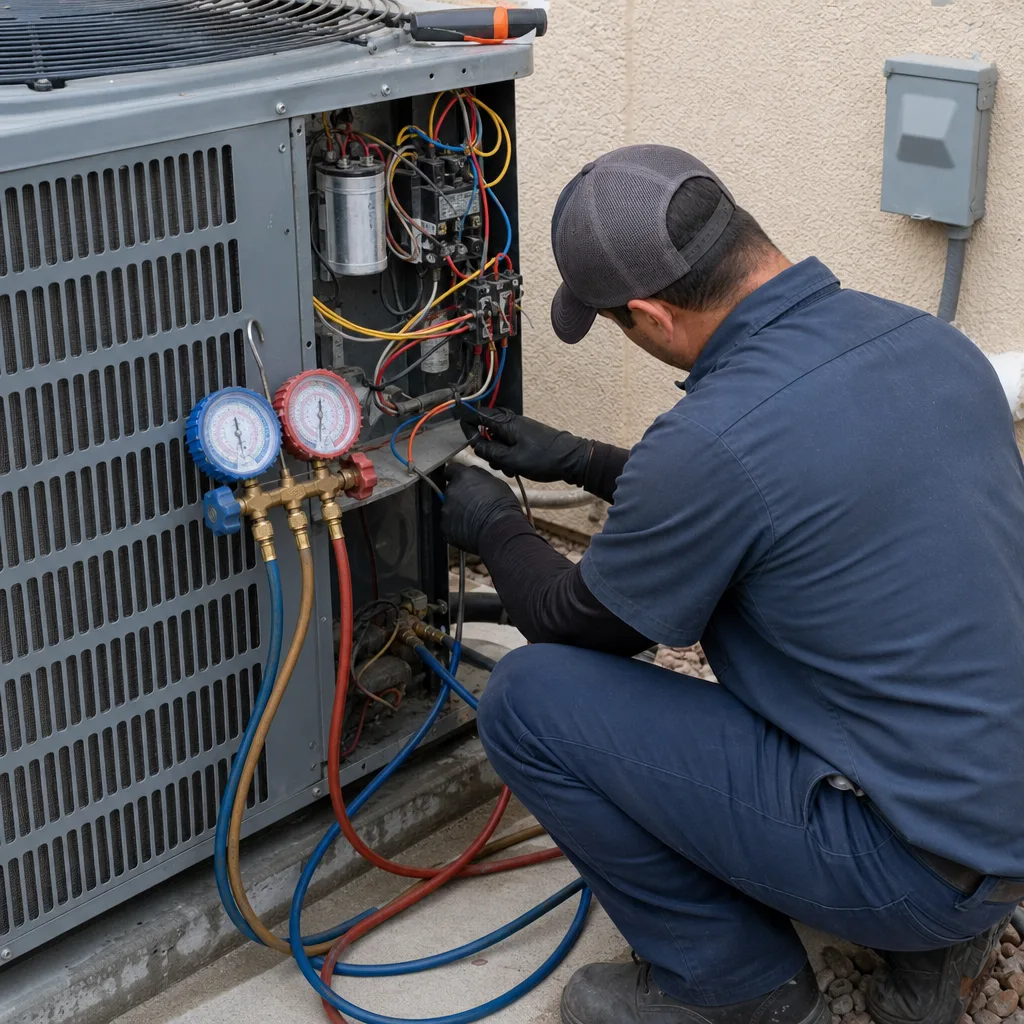
- Static and running pressures measured against the manufacturer’s spec for your equipment – not against a generic chart
- Superheat and subcooling readings, which tell a technician whether the charge is actually low or whether the problem is elsewhere
- A temperature split across the evaporator coil (return air versus supply air)
- Leak detection – electronic sniffing, UV dye, or pressure testing, depending on the system
- A written explanation of what was found before any refrigerant is added
None of that happens with a can of refrigerant from a hardware store, and it shouldn’t. Charging a system without gauges and without finding the leak is how a $200 problem becomes a $2,000 compressor replacement. In Boulder City, where the cooling season runs long and the system works hard for months, that damage compounds faster than most homeowners expect. If your system is cool-but-not-cold, ask specifically whether the technician will check superheat and subcooling. If the answer is vague, that’s your signal.
Warning Signs a Minor Symptom Is Heading for Compressor Failure
The compressor is the heart of the system and the single most expensive component to replace – often half the cost of a new unit on an older system. It rarely fails without warning. Here’s what the warnings look like, and why each one matters:
- The system runs constantly and never reaches setpoint. A system that’s always on is a system working outside its design. If it’s been like this for weeks, the compressor has been running hot for weeks.
- Repeated breaker trips. The compressor is seizing or drawing excess current. Each trip is a symptom, not a fluke.
- A clicking or hard-starting sound from the outdoor unit. The compressor tries to start, clicks off, tries again. This is often a capacitor on its way out – if you catch it, you save the compressor.
- The outdoor unit runs but the fan doesn’t. This is the worst of the bunch, because the compressor will overheat and seize within minutes. If you see this, shut the system off at the thermostat and call.
- Warm air from the vents while the outdoor unit is running normally. This can be a refrigerant loss, a reversing valve issue, or a compressor not pumping. All three need a technician with gauges. None of them fix themselves.
Here’s the honest calculation. A capacitor is a modest part and a single service visit. A compressor is a major repair that often makes an older system uneconomical to fix. Catching the warning signs early is the whole game. When a Boulder City system is limping into its hottest months, that gap between catching a small symptom and losing a compressor is usually a matter of days, not months. Our specialized AC repair team exists precisely for this fork in the road – diagnosing which side you’re on before you commit to a repair.
Documenting Symptoms with Timestamps: The Detail That Cuts Diagnostic Time
Intermittent problems are the hardest calls in the trade. A system that fails at 2pm and works fine at 4pm is telling a technician something specific, but only if they know the pattern. That’s why we ask homeowners to document with timestamps before they call. Here’s how to do it:
- Write down the time, not the feeling. “2:10pm – system on, outdoor fan spinning, air from vents room temperature” is diagnostic. “It felt warm this afternoon” is not.
- Note the outdoor temperature and the thermostat setpoint. A fault that appears only when it’s above 105°F outdoors is a different fault than one that appears at 85°F.
- Record what you did. Did you reset the breaker? Flip the thermostat off and on? Pull the filter? Every reset changes what the system shows the next time it runs.
- Note the pattern – is it consistent or intermittent? Consistent symptoms point to a component. Intermittent symptoms point to a connection, a capacitor, or a thermal fault, which takes a very different diagnostic approach.
- Take a photo or short video of the outdoor unit while the symptom is happening. A fan spinning slowly or a compressor humming without starting is visible, and it saves the technician a second visit to catch it live.
This is a small amount of work that changes the call. An intermittent fault documented with timestamps often diagnoses in one visit. The same fault described only as “it does it sometimes” can take three. That’s not a sales tactic – it’s how diagnostics work, and it’s why our technicians ask for exactly this before they arrive.
Why Boulder City’s Desert Conditions Stress AC Systems Differently
An AC system in Boulder City doesn’t run the way the same equipment runs in a milder climate. The desert heat means longer runtime hours, higher head pressures, and more thermal loading on the compressor and the outdoor fan motor than the manufacturer’s design assumes for a full year. A few things follow from that:
- Runtime hours accumulate faster. A system that runs 8 to 10 hours a day in a milder climate might run 14 to 16 during a Boulder City summer. A 10-year-old system has effectively seen more wear than its age suggests.
- Dust loading on the condenser coil is heavier. Desert dust, pollen, and construction debris clog the outdoor coil’s fins and force the compressor to work against a higher head pressure. Coil cleaning isn’t optional here – it’s basic maintenance.
- Filters load up faster. That means checking more often than the packaging suggests. A filter you’d check every three months elsewhere deserves a look every month during peak season in Boulder City.
- Thermostat setbacks can backfire. A deep afternoon setback followed by a rapid recovery runs the system hard during the absolute worst hours of the day. A gentler setback often cools the house just as comfortably with less compressor strain.
- Shade and attic ventilation matter more than homeowners realize. A unit in full afternoon sun on a 112°F day is working against conditions the manufacturer’s efficiency rating wasn’t measured under.
Our technicians have up to 12 years of experience, and a lot of that has been earned in desert conditions where AC equipment does not get an easy life. That experience is the reason we can tell you that a Boulder City system showing certain symptoms after a hard stretch of heat is often fine, while another showing the same symptoms is a repair waiting to happen. Context matters. And when the answer is “time for a new system,” that’s a conversation about AC installation, not a repair, and we’ll tell you plainly which one you’re looking at.
Brand Matters Less Than You Think – Diagnosis Matters More
Homeowners often ask whether their brand of equipment is easier or harder to service. The honest answer: not really, once a technician knows how to read a system. What matters is whether the technician knows how that specific manufacturer has built the unit – where the service ports are, how the control board is laid out, what the manufacturer’s own superheat and subcooling targets are, and what the common failure points are for that model line.
Our technicians are trained across Carrier, Trane, Lennox, and Goodman, along with the other major brands we service. That matters because we don’t approach a diagnosis by brand preference – we approach it by system condition. A Carrier with a failing capacitor and a Lennox with a failing capacitor are the same call. Recommendations should come from what the equipment is actually doing, not from what any brand or product happens to be easier for the technician to sell. That’s the model we work to, and it’s why our service focus is AC-specific rather than split across heating, plumbing, and electrical work.
If you’re in Boulder City and wondering whether your unit can be saved, that’s a Boulder City-specific question about your specific system, not a brand question. Call (888) 906-2267 and we’ll book a free estimate.
Common Mistakes to Avoid
- Topping off refrigerant without finding the leak. Every top-off that doesn’t locate and fix the leak buys you a few weeks and moves the system closer to compressor failure. Ask what the leak detection plan is before anyone adds anything.
- Resetting the breaker more than twice. A tripped breaker that trips again is a symptom. Continued resets can cause permanent damage to the compressor or the circuit. If it trips twice, stop and call.
- Running the system with ice on the indoor coil. A frozen coil can’t cool, and it can’t drain. Running a system in that state can send water into places it doesn’t belong. Turn it off at the thermostat and call for service.
- Skipping the filter during peak season. A filter that was fine in March can be fully loaded by June in Boulder City. Check it monthly during the cooling season, and replace it when light won’t pass through.
- Describing symptoms in temperature terms only. “It’s 84 in the house and set to 76” is a starting point, but it’s not diagnostic. Describe the outdoor fan, the airflow, the sound, and the temperature split between the return and supply.
- Hiring a generalist for an AC-specific problem. A technician who does plumbing, heating, and AC is spread thin. A specialist knows the equipment already and can diagnose faster. That doesn’t mean the generalist is bad – it means the call is better suited to a specialist.
- Waiting until a small symptom is a compressor problem. A hard-starting system, a humming fan, or a warm vent that’s been like that for weeks is telling you something. Catching it is the difference between a cheap repair and an expensive replacement.
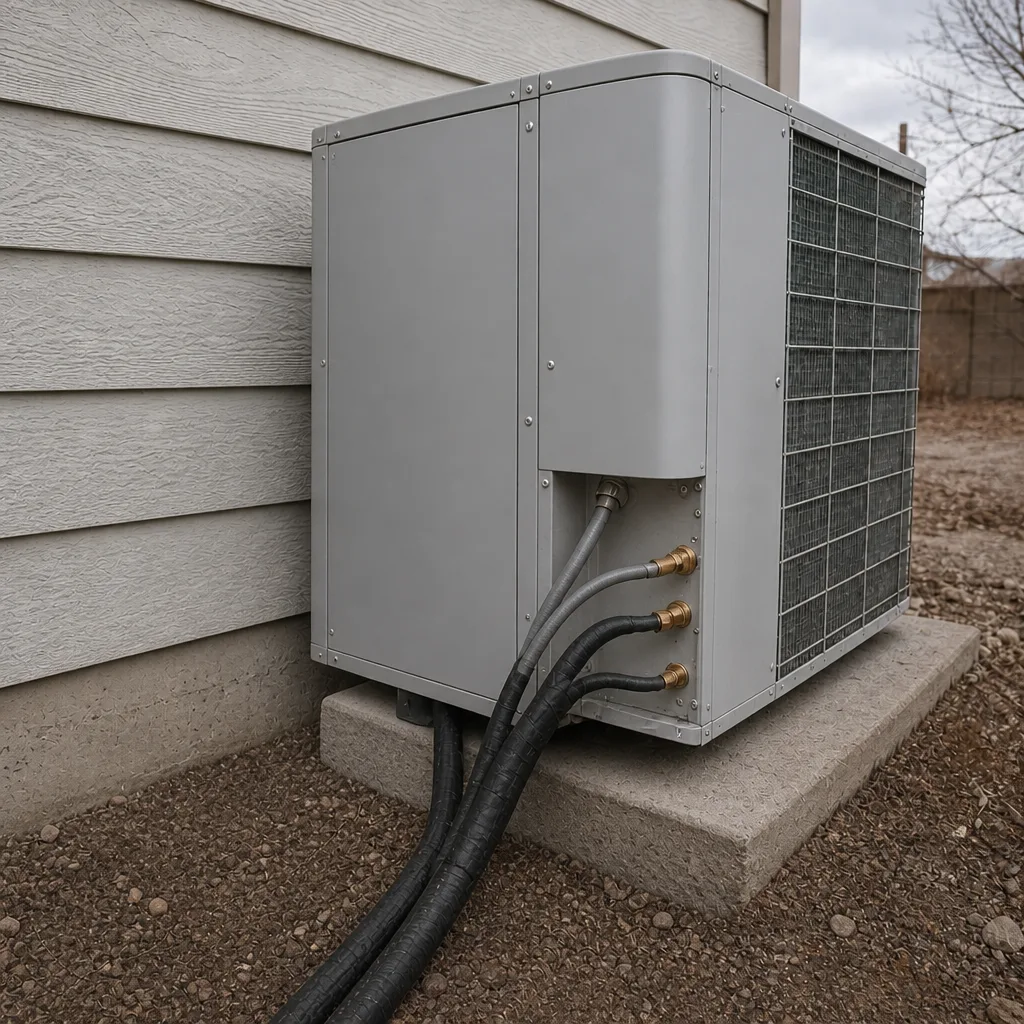
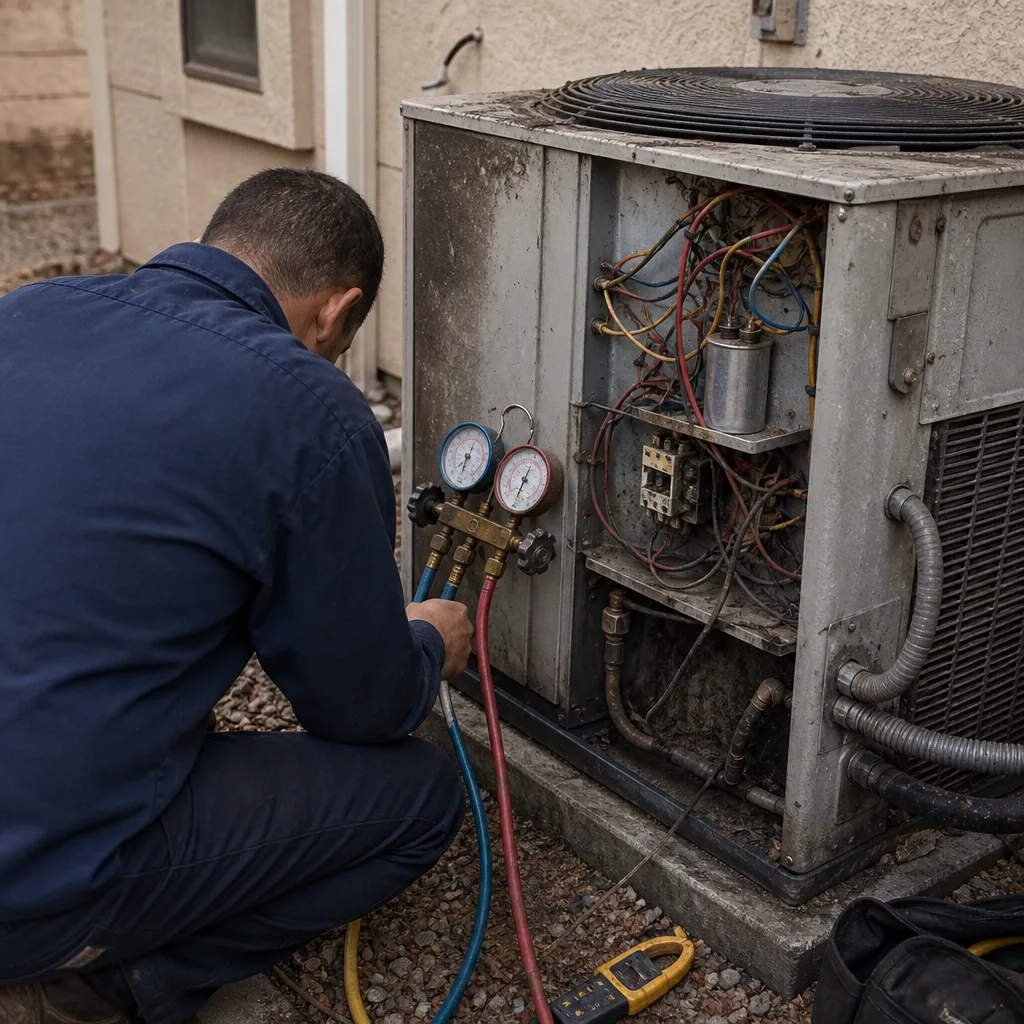
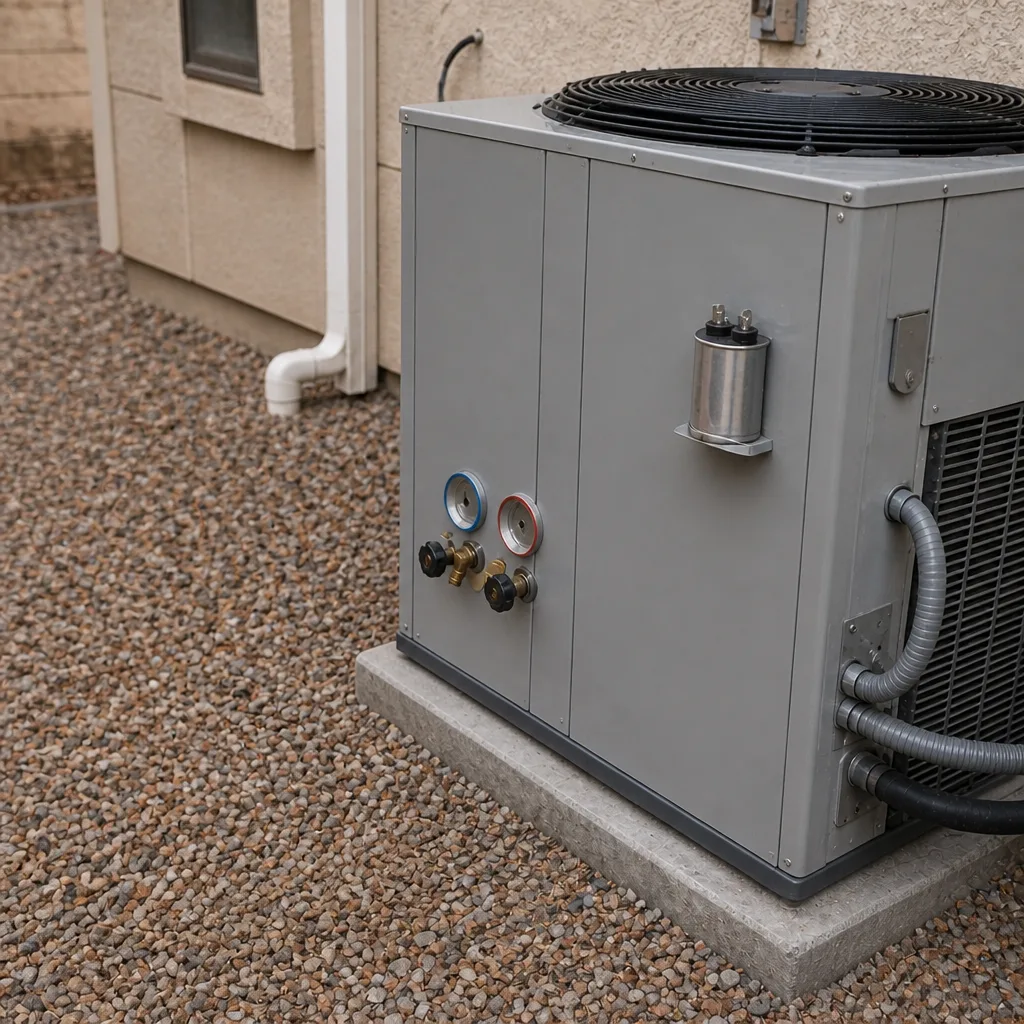
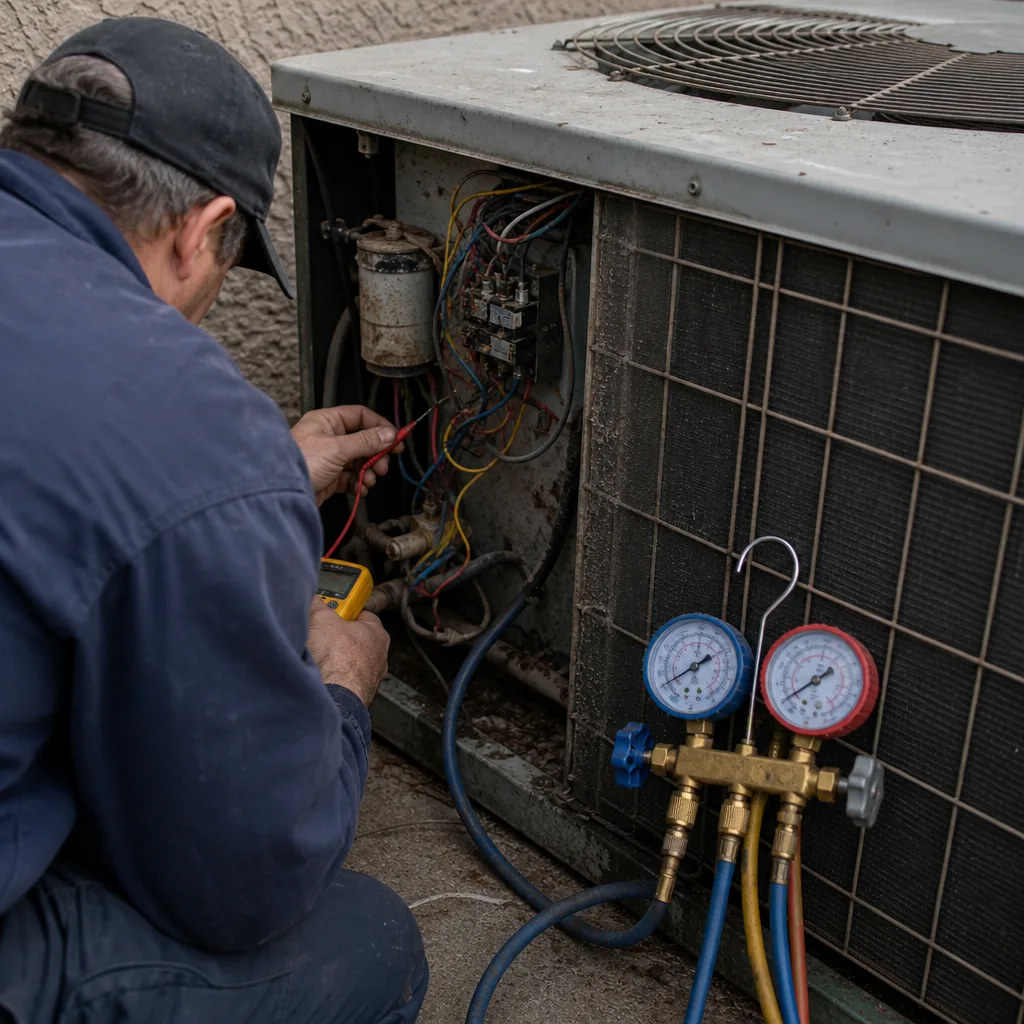
See the difference
 Before
 After
 Before
 After
 Before
 After
When to Call a Professional
Call without troubleshooting if you smell burning from the unit, see ice on the indoor coil, have a breaker that trips twice, or see a pool of water around the indoor unit. Call if the outdoor unit hums but the fan doesn’t spin – that’s a compressor overheat risk every minute it runs. Call if the system runs but produces warm air, if you’ve reset it and it’s still not cooling, or if you’ve seen repeated hard-starting over a stretch of days. And call if you’re unsure whether the symptom is serious – a phone call costs nothing and a wrong guess can cost a lot. AC Repair Boulder City offers free estimates in Boulder City – call (888) 906-2267. We answer 24/7, with fast dispatch from 7am to 7pm, Sunday through Friday.
Frequently Asked Questions
Yes – and you should, within limits. The safe troubleshooting you can do is entirely diagnostic: read the thermostat numbers, check a supply vent for airflow and temperature, look at the outdoor fan and compressor, check the air filter, and reset a tripped breaker once. Anything involving refrigerant, capacitors, motors, coils, or electrical wiring is a professional call. If you’re on the fence, describe what you see to a technician before doing anything else.
It means the system is moving air but not transferring heat, and the likely causes are low refrigerant, a failing compressor, a blocked expansion valve, or (less often) a reversing valve issue. None of these are homeowner-diagnosable – they all require pressure gauges and a technician’s read on superheat and subcooling. Call (888) 906-2267 for a free estimate and don’t keep running the system in that state.
In Boulder City’s heat, a breaker trip can happen because of a hard startup current draw, a failing capacitor forcing the compressor to work harder, a seized compressor, a shorted motor, or a wiring fault. Reset it once. If it trips a second time, stop – continued resets can cause real damage. A free estimate from a technician will tell you which of those it is.
At least every month during peak cooling season, and more often if you have pets, if the filter is a lower MERV rating, or if you’re near active construction. Boulder City dust loads filters quickly, and a loaded filter is the single most preventable cause of a frozen coil and a strained compressor. When in doubt, check it – a filter you can’t see light through is overdue.
It’s serious. A frozen coil means the system is either low on refrigerant or starved for airflow, and continuing to run it in that state can cause compressor damage, water damage to surrounding materials, and a repair that costs far more than the original problem. Turn the system off at the thermostat, thaw it, and call. Don’t just crank up the thermostat and hope.
No. Refrigerant requires EPA Section 608 certification to handle legally and safely, and charging without gauges and a leak diagnosis is how a small problem becomes a compressor replacement. If the system is low, it has a leak – adding refrigerant without finding and fixing the leak means you’ll be repeating the top-off every cooling season. Call (888) 906-2267 and ask what the leak detection plan is before any refrigerant is added.
The Bottom Line
The single most useful thing you can do for your AC is learn to describe what it’s doing, not how the house feels. Read the symptom-to-cause matrix against your system, do the 60-second pre-call check, and document intermittent faults with timestamps. Three fixes – a single breaker reset, a fully-seated disconnect, and thermostat recalibration – are within your scope. Everything else needs a technician with gauges, and the sooner you call on the serious symptoms, the better your odds of catching a small repair before it becomes a compressor. That’s the difference between diagnostic literacy and an expensive education.
If you’re ready for a straight answer from an AC specialist who works on the brand you already have, call (888) 906-2267 for a free estimate. We answer 24/7. Fast dispatch from 7am to 7pm, Sunday through Friday. Our technicians have up to 12 years of experience, and our focus is AC from start to finish – repair, AC installation, and maintenance, all from one team that knows the equipment. Specialists, not generalists.
Written by the team at AC Repair Boulder City.