
Last updated November 17, 2026
 Furnace & heating
 Heat pumps
 Ductless mini splits
 Carrier
 Trane
 Goodman
Seasonal tune-up and full diagnostic on your Carrier, Trane, or Goodman system - readings shown to you before any repair is proposed
Diagnosis first, numbers second - you approve the repair price before a single part goes in.
Get your free estimateHVAC Warning Signs: A Boulder City Homeowner’s Reference Guide
Most warning sign guides hand you a list and send you to the phone. Cold air here, strange noise there, water in the pan, and you’re supposed to know what any of it means. The problem is that two symptoms can look nearly identical from inside a house while pointing at completely different failures. A system that short-cycles in July reads like “working harder.” It’s usually the first reliable clue of a refrigerant leak or a compressor on its way out, and confusing the two is how homeowners approve the wrong repair. This guide maps each symptom to the component most likely failing in a desert-stressed system, so you can tell whether you’re looking at a $30 capacitor or a compressor. Boulder City summers age equipment in ways most national guides don’t account for.
Quick Answer
The warning signs that matter most are short-cycling, warm air from the vents, ice on the indoor coil in summer, musty or burning odors, and rising electric bills without a matching rise in use. Each one points at a small number of likely components, and a technician can usually narrow the list with a temperature split reading. In Boulder City, where summer highs routinely push past 110°F, the same symptoms often trace to different parts than they would in a milder climate. If you’re seeing more than one sign at once, that’s your cue to call rather than wait.
Styles & brands we work with
- AC installation
- Furnace & heating
- Heat pumps
- Ductless mini splits
- Carrier
- Trane
- Goodman
Table of Contents
- Short-Cycling vs. Inadequate Cooling
- What Unusual Odors Actually Tell You
- Ice on the Evaporator Coil in Summer
- The Temperature Split Test
- Signs Specific to Units Over 10 Years Old
- Noises and Bill Creep
- Common Mistakes to Avoid
- Frequently Asked Questions
Short-Cycling vs. Inadequate Cooling: Why They Look Alike
From the couch, both problems feel the same: the house never quite gets comfortable. But short-cycling means the compressor starts and stops in short bursts, often every few minutes. Inadequate cooling means the system runs continuously and still can’t keep up. They are not the same failure, and they don’t lead to the same repair.
Short-cycling is your unit’s way of shutting itself down before it hurts something. Common causes, roughly in order of how often we find them:
- A refrigerant charge that’s off. Low charge makes the compressor overheat, and the safety switch cuts it out. This is the leak scenario, and it doesn’t fix itself.
- A failing compressor. As it wears, it draws more current and trips the overload. A capacitor can mimic this, which is why a technician checks both.
- A clogged filter or restricted airflow. Cheap to fix, but it stresses everything downstream if ignored.
- A thermostat or control board sending bad signals. The equipment is fine; the brain telling it to run isn’t.
Inadequate cooling, by contrast, usually means the system is running but not moving enough heat. A dirty evaporator coil, a failing blower, undersized ductwork, or a system that was never sized right for the space. Here’s the part that matters: if you call about warm air and the technician finds short-cycling, fixing the symptom in isolation can hide a refrigerant leak that will return. That’s why AC repair that starts with diagnostics rather than guesswork saves money on the second visit.
Desert heat accelerates all of this. A Boulder City system running against 112°F outdoor air has less margin for a marginal compressor, so short-cycling shows up here sooner than it might in a milder climate with the same equipment.
What Unusual Odors Actually Tell You
Any smell coming from the vents is a clue, but the type of smell narrows the suspect list fast. Three categories cover nearly everything.
Electrical burning smell
This is the one to take seriously. A hot, sharp, plastic-burning odor points to an electrical problem: a failing compressor, a burnt capacitor, a loose connection at the contactor, or wiring that’s overheating. Turn the system off at the thermostat and don’t run it again until a technician looks. In our experience, this is the odor most often ignored because it comes and goes.
Musty or damp smell
A musty odor usually means mold or mildew is growing somewhere in the air path. In a dry climate like Boulder City’s, that’s less often a whole-house humidity problem and more often standing water in the drain pan, a clogged condensate line, or a wet evaporator coil that isn’t draining right. The fix is often small; the moisture source is the real issue.
Refrigerant smell
Refrigerant itself has a faint, sweet-ish chemical note, sometimes described as similar to a solvent. If you catch that odor, suspect a leak. Refrigerant doesn’t get “used up” in a sealed system, so a low charge means some left the loop somewhere, and the leak needs to be found and fixed, not just topped off. A York or Daikin unit doesn’t leak because of the brand; it leaks at a joint, a Schrader valve, or a coil, and that’s what a technician is looking for.
Ice on the Evaporator Coil in Summer Heat
Ice on an AC in July feels wrong, and it is. Ice forms when the indoor coil runs colder than the air moving across it can handle. Ranked by how often we see them in Boulder City operating conditions:
- Restricted airflow. The most common cause, and the cheapest to fix. A clogged filter, a blower set too low, or a duct problem means not enough warm air crosses the coil, so it freezes. In desert conditions, dust and debris clog filters faster than in most of the country, which pushes this cause to the front.
- Low refrigerant charge. Less refrigerant means lower pressure and a colder coil, and the coil ices over. This often starts at the indoor coil and works back toward the outdoor unit.
- A failed metering device. The valve controlling refrigerant flow can stick, letting the coil over-cool. This one is a technician’s job and rarely a homeowner diagnosis.
What not to do: don’t chip ice off the coil by hand. Copper and aluminum are soft, and a pinhole from a screwdriver turns a thaw into a refrigerant leak. Turn the system off, let it thaw, and have it looked at. A frozen coil that thaws and freezes again on the next cycle is telling you the underlying cause is still there.
One local note: a system that ices on a mild Boulder City morning in the shoulder seasons is more likely an airflow issue than a charge issue, so don’t assume the worst. The season changes the odds.
The Temperature Split Test: A 10-Minute Read Before You Call
You can estimate how well your system is working, and whether it’s worth repairing, before a technician arrives. The temperature split is the difference between the air going into the return and the air coming out of a supply register.
- Hold a thermometer at a return grille for a couple of minutes, or tape a probe there.
- Hold the same thermometer at a supply register near the air handler.
- Subtract the supply reading from the return reading.
- In most home systems, a healthy split is roughly 15 to 20°F. A split under about 15°F suggests the system is struggling to cool. A split over about 22°F can point at restricted airflow or a problem with the indoor coil.
This test doesn’t diagnose. It tells you whether the system is underperforming versus just undersized or fighting an extremely hot day. If your split comes back around 12 to 14°F and the outdoor temp is 110°F, that’s a sign worth a call. The written estimate from a real diagnostic sets the actual repair cost; the split just tells you whether it’s worth picking up the phone.
If you want the underlying method and limits explained in more detail, our team covers it on the AC Repair Boulder City page. The test is a screening tool, and it can’t tell you whether a capacitor or a compressor is the problem. That’s what a technician’s gauges and meter are for.
Warning Signs Specific to Units Over 10 Years Old in Desert Heat
Generic guides calibrate to national averages, and national averages assume a system runs a shorter cooling season than a Boulder City system does. Here, a unit can run seven or eight months a year, mostly in extreme heat. That stress shows up in specific places.
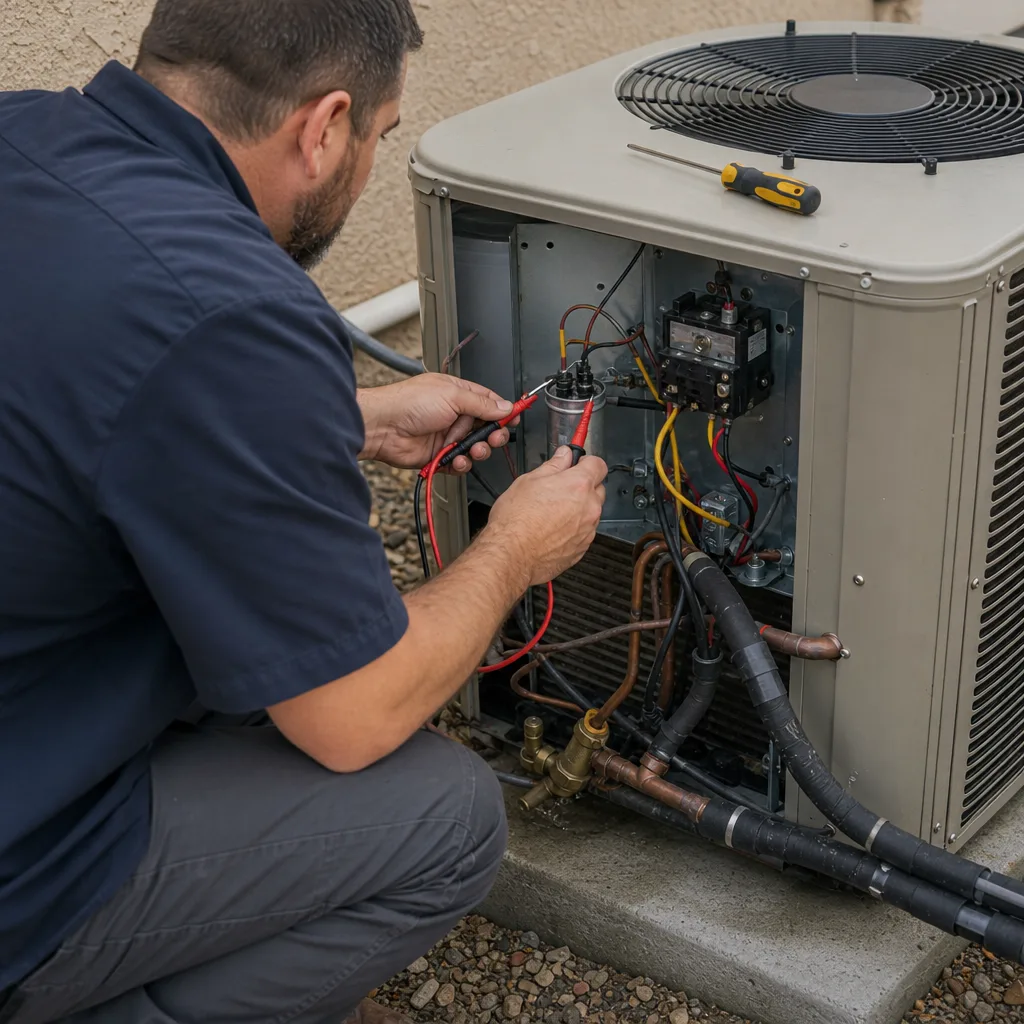
- Capacitors fail early. The start and run capacitors are the cheapest and most common weak point in older equipment. A five-dollar part can look like a dead system, so don’t replace a unit over a capacitor.
- Contactor pitting. The relay switching the compressor wears out from use, and years of extreme-load cycling pitting it faster. Erratic behavior in older units often traces here.
- Fan motor bearing wear. Outdoor fan motors on older units whine or slow down. When the fan struggles, the whole system’s ability to reject heat drops.
- Refrigerant leaks at older joints. Age brings more metal fatigue in coils and lines. A leak in a 12-year-old unit raises the repair-or-replace question honestly, and the math isn’t always obvious.
- Duct leakage in hot attics. Older ductwork in a 120°F attic loses cooling capacity before it reaches a room, and that loss looks like a failing system from inside.
The over-10-year mark is where we stop assuming “it’s just this one thing.” If an old system in Boulder City needs a compressor plus a coil plus a fan motor, the repair bill can approach what a new system costs. A technician should lay out both options plainly, which is the whole point of an AC installation conversation rather than a sales pitch.
Noises and Bill Creep: The Slow Signals
Most homeowners catch loud problems. The quiet ones cost more over time.
Sounds that mean something
- Banging or clanking outdoors. Loose or failing internal compressor parts, or a fan blade hitting debris. Shut it down and call.
- Squealing or grinding. A bearing in the blower or fan motor on its way out. Left alone it can seize.
- Clicking without the fan and compressor kicking on. Often the contactor or capacitor. A cheap fix caught early.
- Hissing along a refrigerant line. Leak. A faint hiss at a leak site is the sound of refrigerant escaping, and it’s a same-day call.
Bill creep
A rising electric bill without a matching change in how often you run the system is a real warning sign. It isn’t proof of a problem, but combined with warm air or longer run times, it points at a system losing efficiency. A dirty coil, low charge, or a blower on its way out all make the compressor work harder for the same result. In a Boulder City summer, that shows up fast. If your bill climbs two months running and nothing else changed, get the system checked before the peak month.
Our technicians have up to 12 years of experience, and one of the first things we ask about is bill history and run time. It’s a cheap way to spot a problem before something fails outright.
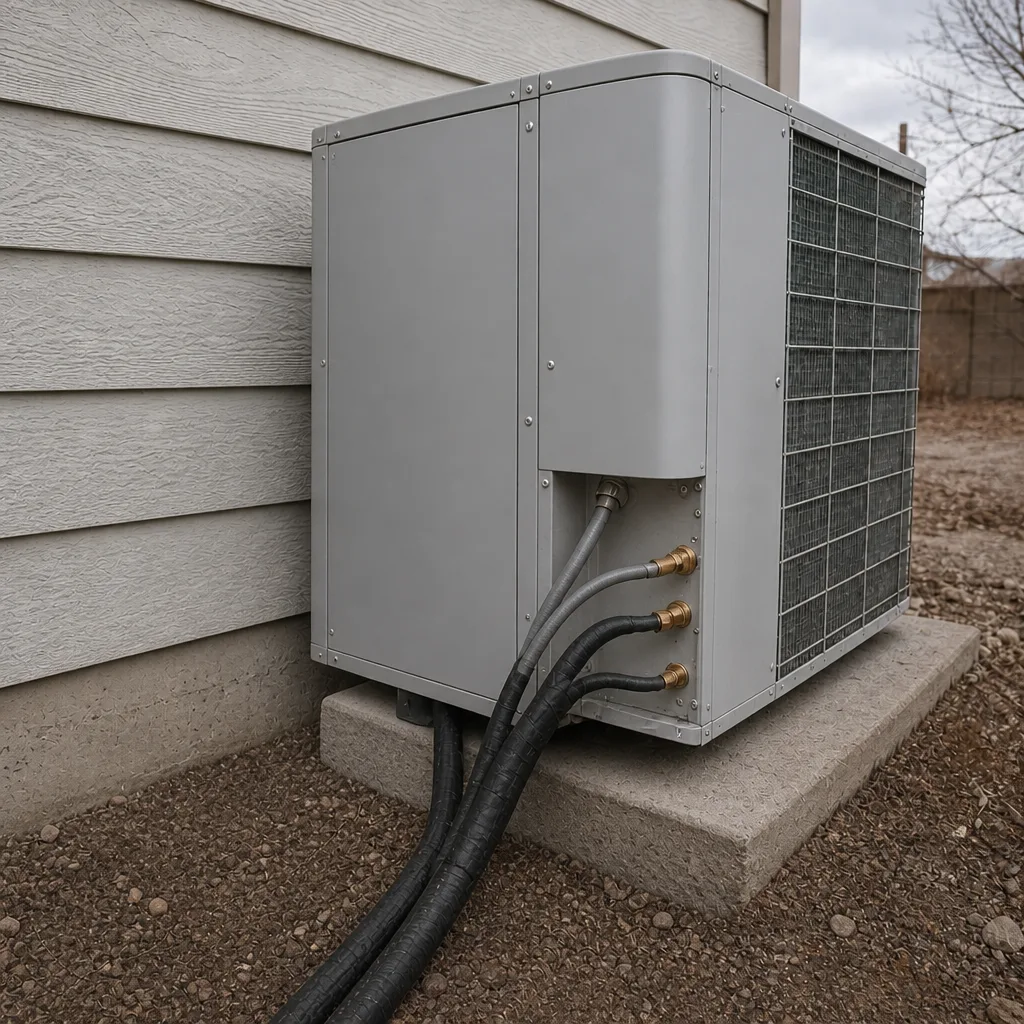
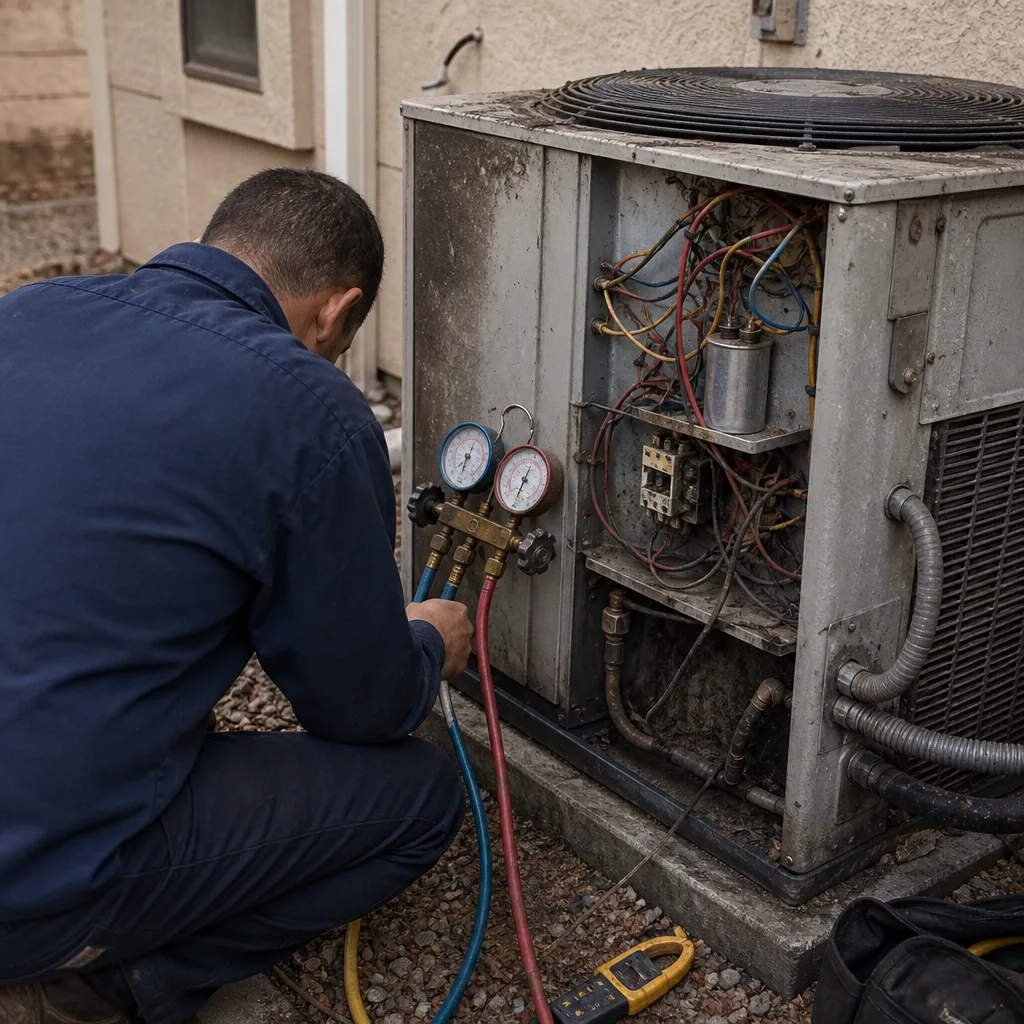
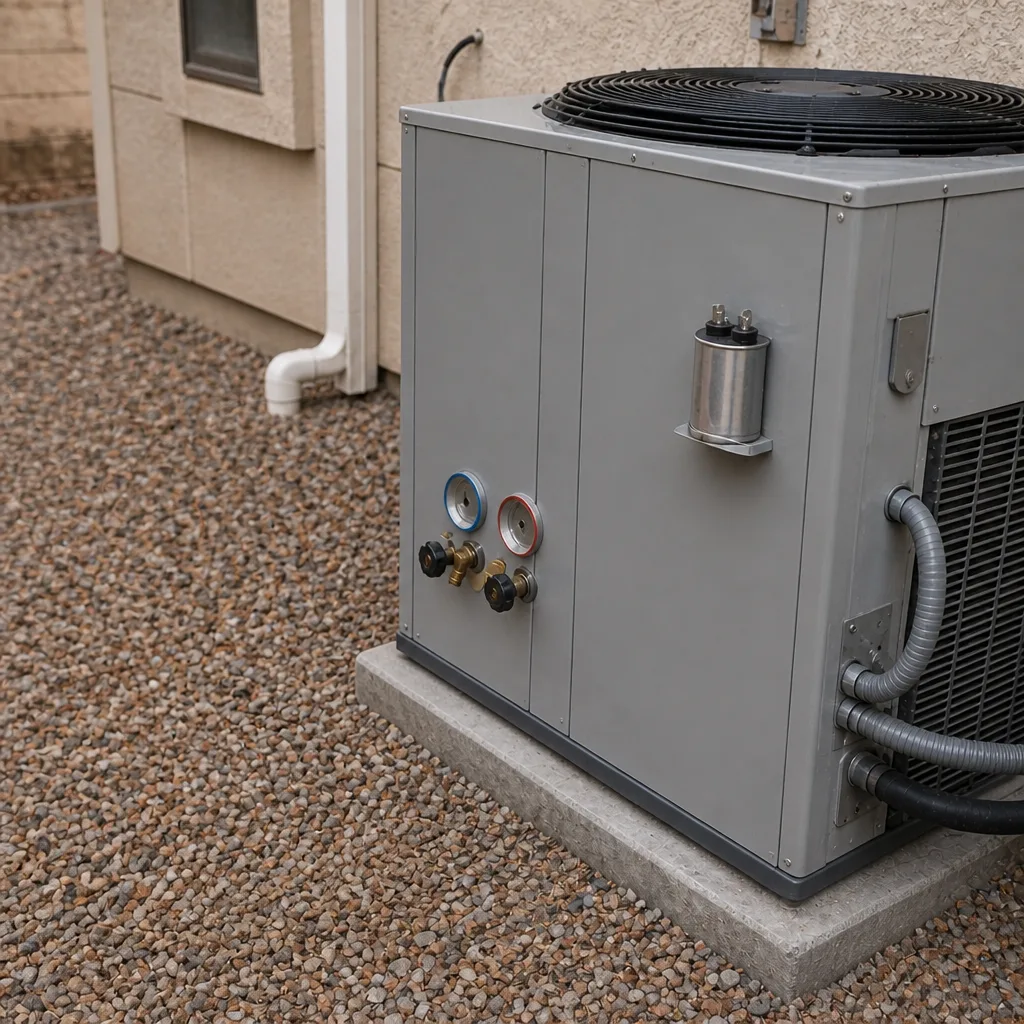
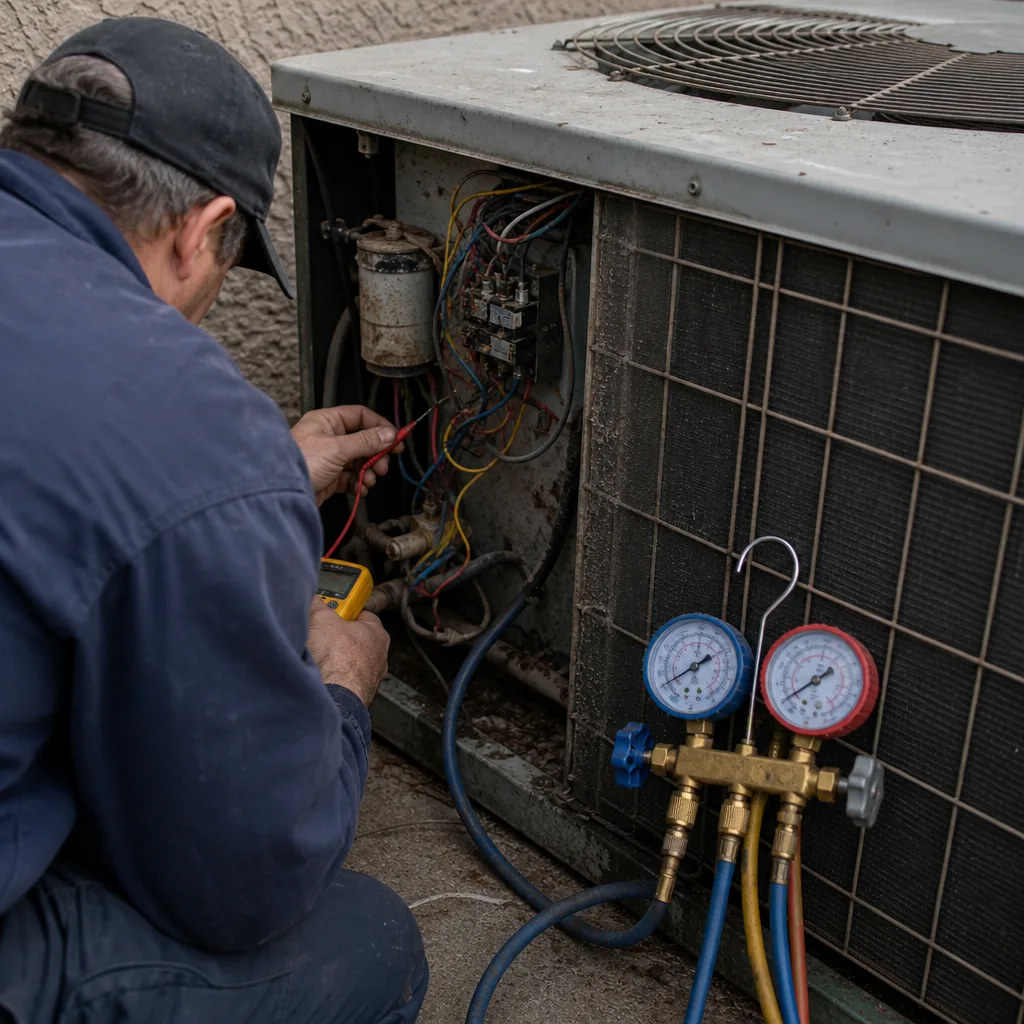
See the difference
 Before
 After
 Before
 After
 Before
 After
Common Mistakes to Avoid
- Topping off refrigerant instead of finding the leak. A sealed system doesn’t consume refrigerant. If it’s low, it leaked somewhere, and that leak will keep coming back. Refill without leak-finding is money that repeats.
- Chipping ice off a frozen coil. One pinhole from a screwdriver turns a thaw into a leak that needs a new coil. Let it thaw and diagnose the cause instead.
- Assuming short-cycling means a failing compressor. A capacitor, a thermostat, or a clogged filter can cause the same symptom. A compressor is the expensive diagnosis, so confirm it before spending.
- Replacing a unit over a bad capacitor. This is the single most avoidable mistake we run into. Get the diagnostic before the estimate.
- Trusting a national “average repair cost.” Desert operating conditions change which parts fail and how often. A Boulder City repair estimate should be based on your system, not a national number.
- Running the system with a burning smell. Electrical odors point at heat somewhere in the circuit. Turn it off and have it checked, even if it smells fine a minute later.
- Ignoring a musty smell until the ceiling shows a stain. By the time a ceiling stains in Boulder City, a condensate line has been leaking for a while. Catch the smell early.
When to Call a Professional
Some signs mean, plainly, that it’s time to call. Warm air from the vents while the outdoor unit runs. Short-cycling that lasts more than a few minutes. Any burning or electrical smell. Ice that forms, thaws, and reforms. A suspected refrigerant leak, including the hiss or sweet odor. A unit over 10 years old showing more than one symptom at once. And any problem you can’t diagnose in 10 minutes with a thermometer, which is most of them.
The dangerous ones deserve their own line. Refrigerant and the electrical components that drive a system can injure or kill an untrained person. Capacitors can hold a charge after power is off, refrigerant can cause frostbite or displace air in an enclosed space, and 240-volt circuits are not a hobby project. A technician with the right tools and training is the right call for anything inside the cabinet. Our technicians are trained on the equipment you’re most likely to own, and we’ll tell you if it’s a small fix.
AC Repair Boulder City offers free estimates in Boulder City, and we answer 24/7. Call (888) 906-2267. Fast dispatch from 7am to 7pm, Sunday through Friday.
Frequently Asked Questions
Short-cycling is the sign to take most seriously early, because it usually points at a refrigerant leak, a compressor on its way out, or a control issue. Any of those get worse with run time. Electrical smells and ice forming in summer are next. Call (888) 906-2267 for an exact quote. Estimates are free.
Ice on the evaporator coil in summer almost always means restricted airflow, low refrigerant charge, or a stuck metering valve, in roughly that order for desert conditions. Clogged filters are common here because of dust. Don’t chip the ice; turn the system off and let a technician find the cause. Call (888) 906-2267 to book a diagnostic.
The honest answer depends on how many parts are failing at once. A single capacitor on a 12-year-old Bryant is a repair. A compressor plus a coil plus a fan motor is usually pointing at replacement, especially in a climate that runs the system as hard as Boulder City does. Get the written estimate both ways before deciding. Call (888) 906-2267 for a free estimate.
A written fixed price based on your home’s load and ductwork, not a national average, is the only number that means anything. We don’t quote over the phone, because an honest price needs a load calculation. Call (888) 906-2267 and we’ll set up a free estimate.
A burning or sharp plastic odor is an electrical problem, such as a failing compressor, a burnt capacitor, a loose connection, or overheating wiring. Turn the system off at the thermostat and don’t run it until it’s checked. Call (888) 906-2267 and we’ll dispatch a technician as soon as we can.
Same-day service is often possible. Call (888) 906-2267 and we’ll tell you what’s open. We answer 24/7, and dispatch runs 7am to 7pm, Sunday through Friday. We’re closed on Saturday, and a call outside dispatch hours is booked into the next opening. Estimates are free.
The Bottom Line
Warning signs aren’t all equal. Short-cycling, ice in summer, and burning or refrigerant odors each point at a small number of specific components, while a warm house on its own could be almost anything. The temperature split test gives you a cheap read on whether it’s worth calling. In Boulder City, the desert heat tips the odds toward capacitors, airflow restrictions, and worn contactors, and against the national averages you’ll find online. Our technicians have up to 12 years of experience, we’re certified on the major brands you already own, and we do AC and only AC. Specialists, not generalists. The right fix, not the easiest upsell.
If you’re seeing two or more signs from this guide, or one that’s been there longer than a few days, it’s time to call. AC Repair Boulder City offers free estimates, written per job, with the price set by the written estimate. Call (888) 906-2267. We answer 24/7. Fast dispatch from 7am to 7pm, Sunday through Friday.
Written by the team at AC Repair Boulder City.